When we look for twentieth-century ancestors, parish registers, civil registration, censuses, military files, household books and obituaries usually come to mind.
There is another source researchers sometimes overlook.
Form No. 1 — the Soviet passport application.
At first glance it is just bureaucracy. For genealogical research, that questionnaire can be extremely valuable.
In it a person — in their own hand or with help from a passport clerk — reported information about themselves. Some of those details can link a Soviet biography to parents, a spouse, a birthplace and earlier stages of life.
What Form No. 1 is
Across periods and jurisdictions the same application is called differently: Form No. 1, Form 1P — an application for issue (or replacement) of a passport. In substance it is the blank filled in when a passport was obtained or exchanged.
It helps to distinguish at least two layers:
- the Soviet blank (including forms tied to the 1974 passport system);
- later national blanks — for example, the modern Russian Form 1P. [2]
Their fields and copy-release rules are not identical. Below I focus on the Soviet questionnaire as a genealogical source, and note later-blank differences where they matter.
To obtain a Soviet passport, a citizen had to submit an application of the prescribed type. The 1974 Statute on the USSR passport system, for example, expressly required an application in the form established by the USSR Ministry of Internal Affairs, a birth certificate, and photographs. [1]
The passport itself held core identity data: surname, given name, patronymic, date and place of birth, and nationality. At first issue, nationality was recorded with regard to the parents’ nationalities; if the parents belonged to different nationalities, the person could choose one of them. [1]
But the passport application could contain far more information than the passport booklet.
That is why a genealogist cares not only about a surviving passport book, but about the paperwork behind its issue.
What you can learn from Form No. 1
The exact set of columns depended on time and blank type, so each form must be read on its own terms.
Even so, such applications often include categories that are especially useful to genealogists.
1. Surname, given name and patronymic
This sounds obvious, but even here there can be important detail.
Soviet documents show how a person themselves wrote their name at a particular moment in life.
That matters especially in families with:
- variant surname spellings;
- Russified given names;
- double surnames;
- surname changes after marriage;
- errors or spelling variants across documents.
Sometimes a Soviet form is what ties a person to an earlier pre-revolutionary record.
2. Date of birth
For a genealogist this is one of the most important fields.
The birth date lets you match Form No. 1 with parish registers, civil registration and other documents where the same person appears at another point in life.
Even a small year gap between family tradition and the form is reason enough to re-check neighbouring years and neighbouring parishes.
3. Place of birth
Specific place of birth is especially valuable.
Instead of a vague “born somewhere near Pinsk,” you may get the name of a concrete village, shtetl or town.
That already opens the next research layer:
place → parish → parish register → birth entry → parents → the next generation.
Place names must be checked in historical context. A village may have changed administrative belonging, joined another district, or been renamed. A modern map search often fails to point to the right archival fond.
4. Nationality
One of the most interesting — and most carefully interpreted — fields.
In the Soviet passport system, nationality was an official questionnaire category. The 1974 Statute states that the passport entry was made with regard to the parents’ nationalities; if they differed, at first issue a person could choose the father’s or the mother’s. [1]
So a Form No. 1 entry can be an important genealogical lead, but it cannot automatically be treated as proof of ethnic origin.
For example:
a person is recorded as Belarusian in a Soviet document
That does not mean every ancestor for several generations identified the same way.
National identity, language, religion and origin can be different historical layers of one family.
It is more useful to compare the entry with:
- parish registers;
- censuses;
- pre-revolutionary questionnaires;
- marriage documents;
- records about parents;
- siblings’ documents.
5. Marital status and parents
On the Form No. 1 blank these details often sit in one block — and this is where the questionnaire can turn from an administrative sheet into a true genealogical source.
Documents could record marriage data: not only the spouse’s full name, but where, with whom and when the marriage was registered. That links two families and points straight to a marriage search.
A useful detail on men’s forms: they often also give the wife’s maiden surname. For a genealogist that is a direct bridge to her parents and pre-marriage family — especially when she is later known only under her husband’s name.
It is especially important when a woman changed her surname after marriage.
For example:
Maria Ivanovna Sidorova
after marriage becomes
Maria Petrovna Kovaleva.
If only the Soviet married surname is known, recovering the maiden name can be hard. A passport form can supply the missing link.
Russia’s modern passport application form, for instance, still has a marital-status block with spouse’s full name and marriage registration details — continuity of the document type itself. [2]
The same block could name the father and mother.
For someone born in the early twentieth century who received a passport in the Soviet period, that can open a generation otherwise reachable only through pre-revolutionary sources.
Imagine this:
You have:
Nikolai Yavorsky, born 1928.
The family only knows he was born somewhere in the Pinsk district.
You find his Form No. 1 and get:
father — Piotr…
mother — …
The search changes completely.
Instead of dozens of possible Piotr Yavorskys, you have a concrete couple — then their marriage, children’s births and, crucially, the previous generation.
One more point: parents’ names on the form do not always match what “everyone in the family knew.” A person might have written a baptismal, everyday or earlier name, while later papers, a gravestone or memory fixed another. Treat the Form No. 1 entry as something to compare with parish registers, certificates and other independent sources — not as a “mistake” to discard when it clashes with family tradition.
6. Place of residence
Especially useful for twentieth-century research.
A passport form could record:
- city or village;
- street;
- house number;
- apartment;
- registration or residence place.
For a genealogist this is not mere biography. It is a point on the map.
If someone was born in a village, then lived in a district centre, moved to Minsk, and after the war lived elsewhere, passport paperwork helps reconstruct movement.
Sometimes the address unlocks the next documents:
- house books;
- resident lists;
- local authority files;
- personnel dossiers;
- enterprise records;
- school papers;
- military files.
One address can open a whole new research branch.
7. Foreign citizenship and arrival in the USSR
Especially interesting for families that crossed former imperial and state borders.
Relevant blanks could ask about previous foreign citizenship and the circumstances of arrival in the USSR.
For most Soviet residents the field was irrelevant. But for someone who:
- came from Poland;
- was born in Lithuania or Latvia;
- lived abroad;
- was repatriated;
- received Soviet citizenship,
such an entry can be a key to another country and archive.
Official USSR passport rules separately provided for documents of persons admitted to Soviet citizenship and those who arrived by repatriation. [1]
8. Passport details
Near the bottom of the form you usually find series and number, issue date, reason for the application (first issue, exchange, and so on) and — crucially — on the basis of which document the passport was issued.
It may be a certificate, another identity paper, a previous passport, a military ID, or something else — depending on the case.
For a genealogist that means:
Form No. 1 may not only give facts itself, but also show what to look for next.
A strong genealogical source does not always answer the main question. Sometimes its value is that it points to the next document.
9. Photograph
The Form No. 1 blank usually has a space for the applicant’s photograph. For a genealogist this is not decoration, but a visual portrait of a person at a fixed point in life: hair, clothes, age, sometimes even traces of occupation or era.
On Soviet blanks tied to the 1974 passport, there were often several photo boxes for different age bands — roughly 16–25, 25–45 and over 45. The current portrait was glued into the box matching the person’s age at issue or exchange. So for someone over 25 the face side may be empty, with the only photo on the reverse.
Later national blanks (for example, modern Russian Form 1P) usually have one current photo on the face side — without adding portraits at later age thresholds.
Such a photograph is especially useful when you need to:
- identify someone on unsigned family photos;
- compare appearance with other documents and albums;
- roughly check age and the period when the form was filled in;
- pass on not only names, but an ancestor’s face.
A practical risk when requesting copies in some jurisdictions: offices sometimes release only the face of the form. If the portrait was on the reverse, you may get a blank “without a face.” Ask which sides are copied, and request the reverse when needed.
Even if the application survives without a glued-in print, the fact that a photograph was attached to the passport file suggests another portrait of the same person from the same period may exist in archival materials or a family archive.
Form No. 1 in a concrete example
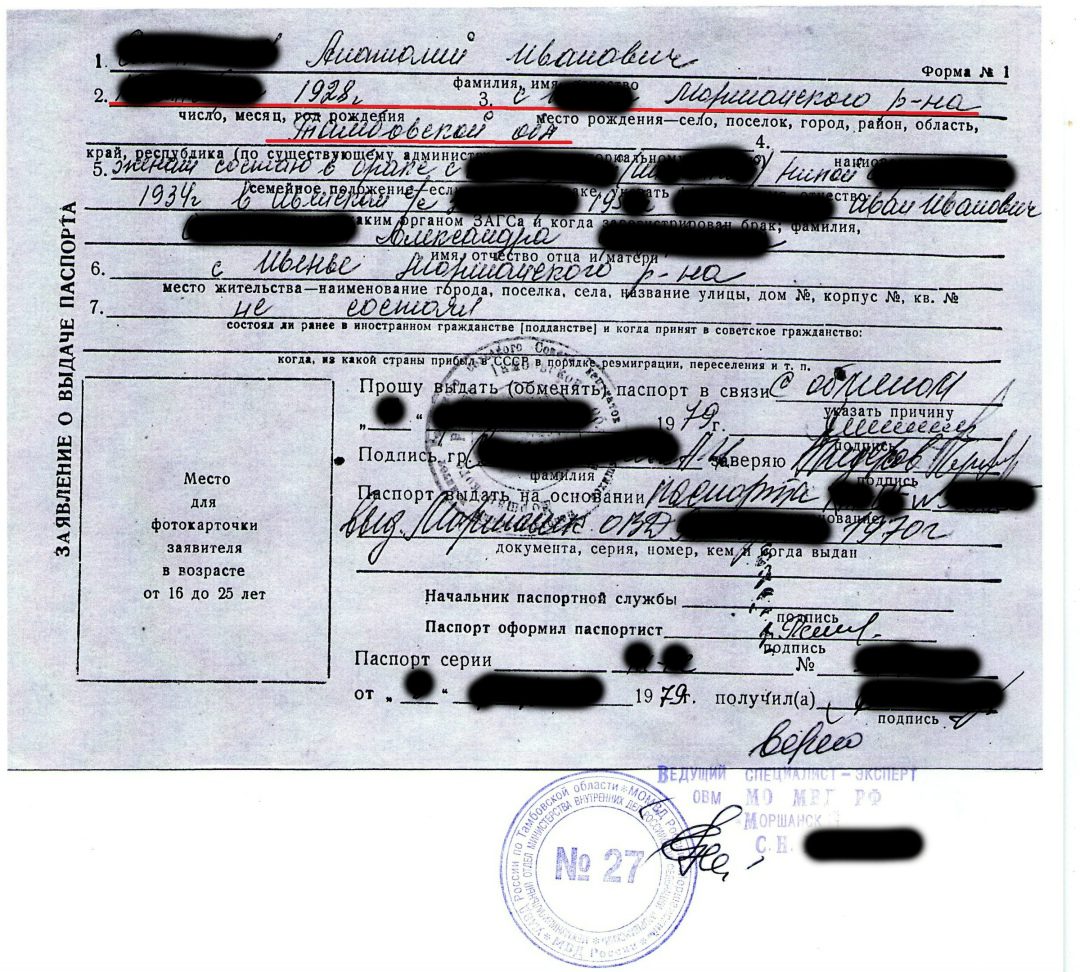
In the photograph above — a Soviet passport application, Form No. 1.
Such documents matter because we are not reading family stories retold across generations, but information recorded in the person’s lifetime and submitted to a state office.
One sheet often holds several independent information blocks:
- Full name — core identity.
- Date of birth — to match parish and civil records.
- Place of birth — starting point for a birth search.
- Nationality — to compare with other sources.
- Marital status and parents — to seek marriage registration (where / with whom / when), sometimes the wife’s maiden surname, and connect the person to the previous generation.
- Place of residence — geography of life.
- Foreign citizenship — a possible key to another state and archive.
- Passport details — series, number, issue date, and the document on which the passport was issued.
- Photograph — a portrait at passportisation; on Soviet blanks sometimes on the reverse, in the age-band box.
The last points are easy to underestimate.
The passport form as a bridge between eras
There is another reason I like these papers.
Genealogy often hits a gap. For example:
grandfather born in the 1920s → unknown parents → pre-revolutionary family.
You have Soviet photos, memories and a few late documents.
Then Form No. 1 appears in an archive. And it gives:
birth date → birthplace → parents → spouse → residence.
A Soviet biography joins pre-revolutionary genealogy. Research can continue:
Form No. 1 → parents → marriage entry → parish register → parents’ parents → next generation
An ordinary passport form becomes part of a larger genealogical graph.
An important limitation
Form No. 1 is not absolute truth.
Like any source, it may contain:
- errors;
- slips of the pen;
- wrong dates;
- simplified place names;
- name and surname spelling differences;
- information based on the applicant’s own words.
Also, forms from different periods could differ.
The right approach is not simply to copy the form into a family tree, but to treat it as evidence and as a pointer for further search.
For example:
Form No. 1 states place of birth X.
Next question:
Is there a birth entry for this person in the corresponding parish?
If yes — excellent: independent confirmation. If not — check neighbouring parishes, administrative changes, place-name variants and possible error in a later document.
Where to look for Form No. 1
Here things get hardest.
A passport questionnaire is rarely sitting in a family album next to a parish extract.
Such files were typically created in internal-affairs bodies and other institutions responsible for passport registration. Search therefore starts with archives and fonds linked to passport offices, militia and interior agencies, for the specific region and period — and usually where the person received or exchanged the passport.
If a Soviet passport was issued in one city and later exchanged for a post-Soviet one elsewhere, you often need two different requests.
Survival and a chronological filter
In practice, card indexes more often keep blanks tied to the 1974-model passport. Earlier passport cards were destroyed in many places. The 1974 USSR passport statute provided for issuing the new passports from 1 January 1976 to 31 December 1981. [1]
Working takeaway: if an ancestor was still alive around 1976 or later, the chance of finding a form from that period is meaningfully higher — and the request is almost always worth making.
There is no universal answer like:
“Go to archive X and ask for Form No. 1.”
First establish:
- where the person received the passport;
- in which year;
- which body then issued passports;
- whether the corresponding fonds survive;
- whether researchers have access;
- what restrictions apply to twentieth-century records.
Access to copies: an important caveat
Copy-release rules depend on country and period. In the Russian Federation, for example, a Form 1P copy is often available not to any relative, but to an heir (or someone with the heir’s proper consent to process the deceased’s personal data). That is not the same as a civil- registration (ZAGS) request, where the circle of applicants differs. Officially a personal visit is often required; in practice remote release sometimes works — but you cannot count on it alone.
In Belarus and other former Soviet countries the procedure, retention periods and who may request a copy can differ. In Belarus you can request a copy of such a form via the appeals portal обращения.бел. Either way, first check local rules, then address the request to the place of passport issue.
Sometimes Form No. 1 will be unavailable. Even then, knowing it exists helps — an archival request can be framed much more precisely.
What to search alongside Form No. 1
If you find an ancestor’s passport form, I would not stop there. It can yield a map of further research.
If you found a birth date
- parish entry;
- civil registration;
- birth certificate;
- school papers.
If you found parents
- parents’ marriage;
- siblings’ births;
- parish registers;
- censuses;
- household books.
If you found a spouse
- marriage entry;
- previous surname;
- children;
- the spouse’s family.
If you found an address
- house books;
- resident lists;
- workplace files;
- local censuses;
- authority records.
If you found a birthplace
- parish;
- archival fond;
- parish registers;
- confession lists;
- revision lists, if the period allows;
- censuses;
- other local sources.
If you found arrival from another country
That is a separate research branch:
USSR → country of origin → concrete place → local archive → family.
The real point: look beyond the passport booklet
This may be the main takeaway.
When we say:
“We still have great-grandfather’s passport,”
we usually mean the booklet.
For a genealogist the more interesting trail may be the whole documentary chain around the passport:
application → supporting documents → passport → registration records → later changes.
Each paper fixes a person at a point in life. Our job as genealogists is to connect those points.
Form No. 1 as a genealogical detective tool
Twentieth-century genealogy often needs a different approach than eighteenth- or nineteenth-century work. Parish books alone are not enough.
You collect a person’s traces:
passport → address → work → marriage → children → military service → move → archival file.
Form No. 1 can be one of those traces.
Its value sits at the intersection of several information types:
person + family + place + date + state document.
Sometimes that is enough to move from a guess to the next piece of evidence.
If you are researching your family
Look through old family papers. You may still have a Soviet passport, a copy, or photos of documents tied to its issue.
If the passport itself is gone, the trail is not necessarily lost.
The passport may have vanished. The document used to issue it may still sit in an archive.
Sometimes one such sheet adds several new names to a family tree at once.
A short methodological caveat
Not every Form No. 1 contains every category listed here. Blanks and rules changed over time, so research must look at the specific specimen and year. The 1974 Statute defined mandatory passport data and required an MVD-prescribed application, while the concrete content of the application was set by relevant instructions. [1]
Looking for Soviet-period ancestors?
Do not stop at parish registers and civil registration. Passport forms, personnel files, household books and other twentieth-century records can hold facts missing from family papers.
Heritavia connects archival documents, family stories and DNA into one family history.